
Remote TPMS Check API Developer Guide
Service Overview
The Remote Tire Pressure Monitoring System (TPMS) service is a telematics service that allows users to remotely monitor their vehicle's tire pressure and receive alerts through mobile apps or web platforms.
Service Features
- Real-time tire pressure monitoring
- Tire pressure alerts and warnings
- Tire temperature monitoring
- Tire health status tracking
- Maintenance recommendations
Legal Requirements
- Compliance with Personal Information Protection Act
- Explicit consent required for sensor data collection
- Compliance with data retention policies
- Safety regulation compliance
Key Scenarios
Scenario 1: Tire Pressure Update Request and Processing
API Flow by Entity:
📱 App (User):
- TPMS Request: Request tire pressure update
- Status Check: Check TPMS update status (in progress/completed)
- Alert Reception: Receive tire pressure alert notifications
🚗 Vehicle (TCU):
- Sensor Data Collection: Collect tire pressure and temperature data from all sensors
- Data Transmission: Transmit sensor data to server
- Alert Detection: Detect abnormal tire pressure conditions
🏢 Call Center:
- Duplicate Request Prevention: Apply duplicate request prevention logic
- Command Transmission: Send TPMS update command to vehicle
- Data Processing: Process and validate received sensor data
- Alert Generation: Generate tire pressure alerts
- Storage: Store sensor data with timestamp
Scenario 2: Real-time Tire Pressure Query
API Flow by Entity:
📱 App (User):
- TPMS Query: Query current tire pressure status
- Pressure Display: Display tire pressure for all tires
- Status Indication: Display tire pressure status indicators
🏢 Call Center:
- TPMS Provision: Provide latest tire pressure status
- Status Management: Automatic management of tire pressure status
- Data Caching: Efficient caching of sensor data
- Status Analysis: Analyze tire pressure patterns
Scenario 3: Tire Pressure History Query
API Flow by Entity:
📱 App (User):
- History Query: Query tire pressure history
- History Display: Display tire pressure history charts
- Trend Analysis: Display tire pressure trend analysis
🏢 Call Center:
- History Management: Automatic management of tire pressure history
- Pattern Analysis: Analyze tire pressure patterns
- Statistics Generation: Generate tire pressure statistics
Scenario 4: Tire Pressure Alerts and Warnings
API Flow by Entity:
📱 App (User):
- Alert Setup: Configure tire pressure alerts
- Alert Reception: Receive tire pressure alert notifications
- Alert Management: Manage alert preferences
🏢 Call Center:
- Alert Monitoring: Monitor tire pressure for alert conditions
- Alert Generation: Generate tire pressure alerts
- Push Notifications: Send push notifications to user app
- Escalation: Escalate critical alerts to call center
Scenario 5: Tire Health Analysis
API Flow by Entity:
📱 App (User):
- TPMS Query: Query current tire pressure status
- Pressure Trend Query: Query tire pressure history trends
- TPMS Check Request: Request real-time tire pressure update
🏢 Call Center:
- Event Stream Provision: Provide real-time TPMS event stream
- Event Transmission: Transmit TPMS change events in real-time
Scenario 7: Tire Pressure Calibration
API Flow by Entity:
📱 App (User):
- Alert Configuration Update: Configure tire pressure alerts and thresholds
- Alert Results: Receive notifications when tire pressure abnormalities are detected
🏢 Call Center:
- Calibration Processing: Process tire pressure calibration requests
- Calibration Execution: Execute calibration procedures
- Calibration Validation: Validate calibration results
Key Features
📱 Features to Implement in App
1. Tire Pressure Monitoring
- Pressure Query: Query current tire pressure immediately
- Pressure Display: Display tire pressure for all tires
- Status Indicators: Display tire pressure status indicators
- Real-time Updates: Real-time tire pressure updates
- Temperature Display: Display tire temperature information
2. Tire Pressure History
- History Query: Query tire pressure history
- Chart Display: Display tire pressure history charts
- Trend Analysis: Display tire pressure trend analysis
- Statistics: Display tire pressure statistics
3. Alerts and Notifications
- Alert Setup: Configure tire pressure alerts
- Alert Reception: Receive tire pressure alert notifications
- Alert Management: Manage alert preferences
- Alert History: Display alert history
4. Tire Health Analysis
- Health Query: Query tire health analysis and trends
- Health Display: Display tire health status
- Recommendations: Display maintenance recommendations
- Health Tracking: Track tire health over time
5. Calibration and Settings
- Update Request: Request real-time tire pressure update
- Settings Management: Manage TPMS settings
- Sensor Status: Display sensor status information
6. Real-time Event Reception
- Update Request: Request real-time tire pressure update
- Manual Check: Initiate manual tire pressure sensor reading
🏢 Features to Implement in Call Center
1. TPMS Data Collection System
- Data Reception: Receive tire pressure data in real-time
- Data Storage: Secure storage of sensor data
- TPMS Management: Automatic management of latest TPMS data
- Quality Management: Manage sensor data quality and accuracy
- Data Validation: Validate sensor data validity
2. TPMS History Management System
- History Collection: Automatic collection of tire pressure history
- History Management: Automatic management of TPMS history
- Pattern Analysis: Automatic analysis of tire pressure patterns
- Statistics Generation: Automatic generation of tire pressure statistics
3. Alert and Warning System
- Alert Monitoring: Monitor tire pressure for alert conditions
- Alert Generation: Automatic generation of tire pressure alerts
- Push Notifications: Automatic sending of push notifications to user app
- Alert Escalation: Escalate critical alerts to call center
- Alert Configuration: Management of alert configurations
4. Tire Health Analysis System
- Health Analysis: Automatic analysis of tire health
- Recommendation Generation: Generate maintenance recommendations
- Health Tracking: Track tire health over time
- Predictive Analysis: Predict tire maintenance needs
5. Calibration System
- Update Processing: Process real-time update requests
- Calibration Execution: Execute calibration procedures
- Calibration Validation: Validate calibration results
- Calibration History: Manage calibration history
6. API Service Management
- API Response Processing: Process TPMS related API requests
- Request Validation: Validate API requests
- Performance Monitoring: Monitor API response time and availability
- Error Handling: Handle API errors and exceptions
- Version Management: Manage API versions and compatibility
7. Security and Privacy
- Sensor Data Consent: Manage consent for sensor data collection
- Privacy Protection: Protect user sensor data privacy
- Data Security: Secure processing of sensor data
- Audit Logging: Maintain audit logs for sensor data access
- Access Control: Manage user-specific TPMS access permissions
8. System Operations and Monitoring
- System Status Monitoring: 24/7 monitoring of TPMS system
- Data Quality Management: Manage sensor data quality and accuracy
- Sensor Status Monitoring: Monitor TPMS sensor communication status
- Exception Handling: Handle network, sensor, data processing exceptions
- System Optimization: Optimize TPMS data processing logic
9. Data Analysis and Statistics
- Pattern Analysis: Automatic analysis of tire pressure patterns
- Usage Statistics: Automatic generation of TPMS usage statistics
- Service Quality Analysis: Automatic analysis of TPMS service quality
- Improvement Recommendations: Automatic generation of service improvement recommendations
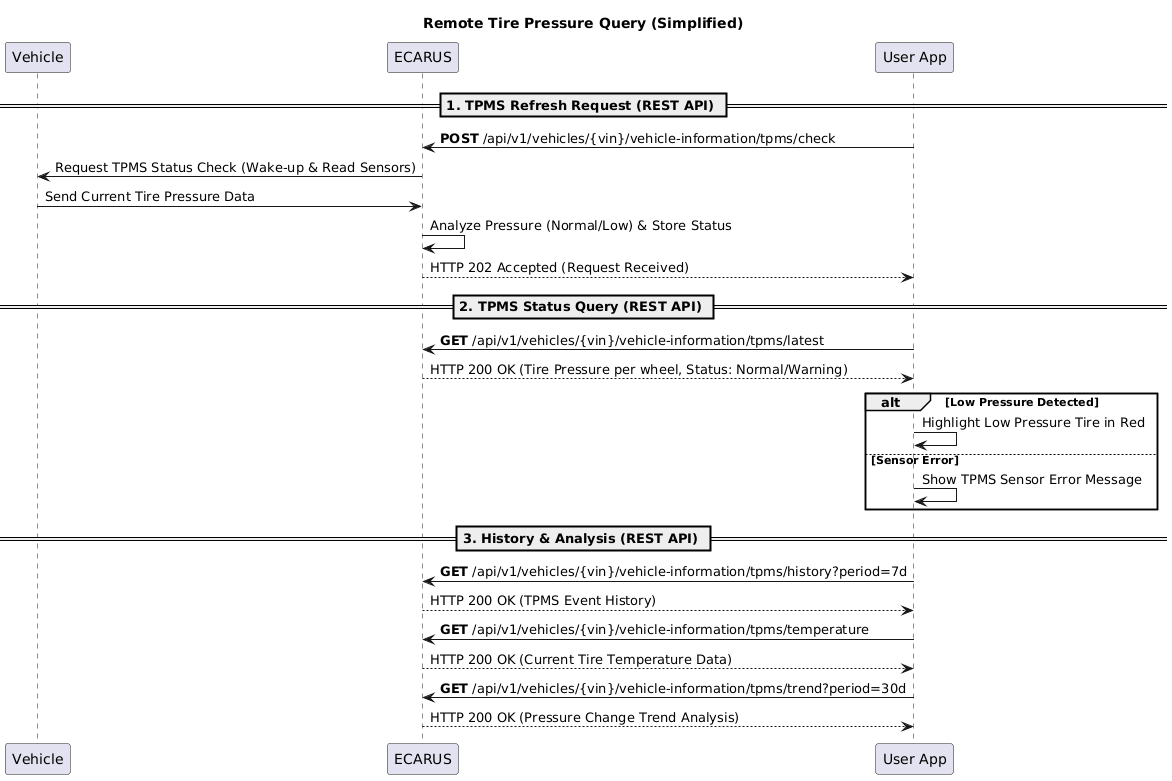
Sequence Diagram
Remote TPMS System Flow
API Endpoints
Refer to the Common API Specifications for headers, response codes, and error formats.
Refer to the Common API Specifications for headers, response codes, and error formats.
Current Tire Pressure Query
curl -X GET "https://api.ecarus.run/api/v1/information/vehicles/KMHSH81C7LU123456/tpms/latest" \
-H "Authorization: Bearer sk_4f9c7b8e2d1a6c0f3e7a9b5d8c1e4f2a7c6d9e0b3f5a8c1d4e7f9b2c6a1e3d"Tire Pressure History Query
curl -X GET "https://api.ecarus.run/api/v1/information/vehicles/KMHSH81C7LU123456/tpms/trend?limit=10" \
-H "Authorization: Bearer sk_4f9c7b8e2d1a6c0f3e7a9b5d8c1e4f2a7c6d9e0b3f5a8c1d4e7f9b2c6a1e3d"Tire Pressure Update Request
curl -X POST "https://api.ecarus.run/api/v1/information/vehicles/KMHSH81C7LU123456/tpms/check" \
     -H "Authorization: Bearer sk_4f9c7b8e2d1a6c0f3e7a9b5d8c1e4f2a7c6d9e0b3f5a8c1d4e7f9b2c6a1e3d" \
     -H "Content-Type: application/json" \
-d '{"priority": "HIGH", "timeout": 30}'Tire Pressure Alert Configuration
curl -X PUT "https://api.ecarus.run/api/v1/information/vehicles/KMHSH81C7LU123456/tpms/alerts" \
     -H "Authorization: Bearer sk_4f9c7b8e2d1a6c0f3e7a9b5d8c1e4f2a7c6d9e0b3f5a8c1d4e7f9b2c6a1e3d" \
     -H "Content-Type: application/json" \
-d '{"lowPressureThreshold": 28, "highPressureThreshold": 35, "temperatureThreshold": 70}'Data Models
Tire Pressure Information Response
{
  "vin": "KMHSH81C7LU123456",
  "userId": "user123",
  "timestamp": "2026-01-13T14:30:00Z",
  "tpms": {
    "frontLeft": {
      "pressure": 32.5,
      "temperature": 25.5,
      "status": "NORMAL",
      "lastUpdate": "2026-01-13T14:30:00Z",
      "sensorId": "TPMS-001",
      "batteryLevel": 85
    },
    "frontRight": {
      "pressure": 32.8,
      "temperature": 26.2,
      "status": "NORMAL",
      "lastUpdate": "2026-01-13T14:30:00Z",
      "sensorId": "TPMS-002",
      "batteryLevel": 82
    },
    "rearLeft": {
      "pressure": 31.9,
      "temperature": 24.8,
      "status": "NORMAL",
      "lastUpdate": "2026-01-13T14:30:00Z",
      "sensorId": "TPMS-003",
      "batteryLevel": 88
    },
    "rearRight": {
      "pressure": 32.2,
      "temperature": 25.1,
      "status": "NORMAL",
      "lastUpdate": "2026-01-13T14:30:00Z",
      "sensorId": "TPMS-004",
      "batteryLevel": 79
    }
  },
  "system": {
    "overallStatus": "NORMAL",
    "lastCalibration": "2025-12-01T10:00:00Z",
    "nextCalibration": "2026-06-01T10:00:00Z",
    "sensorCount": 4,
    "activeSensors": 4
  },
  "alerts": [
    {
      "alertId": "alert-001",
      "type": "LOW_PRESSURE",
      "severity": "MEDIUM",
      "tire": "rearLeft",
      "message": "Rear left tire pressure is below recommended level",
      "currentPressure": 28.5,
      "recommendedPressure": 32.0,
      "timestamp": "2026-01-13T14:30:00Z",
      "acknowledged": false
    }
  ]
}Tire Pressure History Response
{
  "vin": "KMHSH81C7LU123456",
  "userId": "user123",
  "period": "30d",
  "limit": 10,
  "offset": 0,
  "history": [
    {
      "readingId": "reading-001",
      "timestamp": "2026-01-13T14:30:00Z",
      "tpms": {
        "frontLeft": {"pressure": 32.5, "temperature": 25.5},
        "frontRight": {"pressure": 32.8, "temperature": 26.2},
        "rearLeft": {"pressure": 31.9, "temperature": 24.8},
        "rearRight": {"pressure": 32.2, "temperature": 25.1}
      },
      "overallStatus": "NORMAL",
      "drivingCondition": "PARKED"
    },
    {
      "readingId": "reading-002",
      "timestamp": "2026-01-13T09:15:00Z",
      "tpms": {
        "frontLeft": {"pressure": 33.2, "temperature": 28.5},
        "frontRight": {"pressure": 33.5, "temperature": 29.1},
        "rearLeft": {"pressure": 32.8, "temperature": 27.8},
        "rearRight": {"pressure": 33.1, "temperature": 28.2}
      },
      "overallStatus": "NORMAL",
      "drivingCondition": "DRIVING"
    }
  ],
  "total": 720,
  "hasMore": true,
  "nextOffset": 10
}Tire Pressure Alert Configuration Response
{
  "vin": "KMHSH81C7LU123456",
  "userId": "user123",
  "timestamp": "2026-01-13T14:30:00Z",
  "alerts": {
    "pressure": {
      "lowPressureThreshold": 28.0,
      "highPressureThreshold": 35.0,
      "rapidDropThreshold": 2.0,
      "unit": "PSI"
    },
    "temperature": {
      "highTemperatureThreshold": 70.0,
      "rapidRiseThreshold": 10.0,
      "unit": "CELSIUS"
    },
    "notifications": {
      "pushEnabled": true,
      "emailEnabled": false,
      "smsEnabled": false,
      "severityFilter": ["MEDIUM", "HIGH", "CRITICAL"]
    },
    "schedule": {
      "monitoringEnabled": true,
      "quietHours": {
        "start": "22:00",
        "end": "07:00",
        "criticalAlertsEnabled": true
      }
    }
  },
  "previousSettings": {
    "pressure": {
      "lowPressureThreshold": 29.0,
      "highPressureThreshold": 36.0
    }
  },
  "validation": {
    "isValid": true,
    "warnings": [
      "Low pressure threshold may trigger frequent alerts in cold weather"
    ],
    "errors": []
  }
}Security and Privacy
Authentication and Authorization
- User authentication token required (JWT/OAuth2)
- Vehicle access permission verification
- TPMS query permission confirmation
Data Security
- All API communications encrypted with HTTPS/TLS
- Secure transmission of sensor data
- Protection of sensitive vehicle information
Privacy Protection
- Explicit consent for sensor data collection
- Compliance with data retention policies
- Right to data deletion upon user request
Access Control
- VIN-based vehicle access permission verification
- User-specific TPMS access permission management
- Detection of abnormal access patterns
Exception Handling
Network Related
- Connection Failure: Offline mode support, last sensor data caching
- Slow Response: Loading indicator, timeout handling
- Server Down: Error message display, retry suggestion
Sensor Related
- Sensor Malfunction: Sensor malfunction notification
- Sensor Battery Low: Sensor battery low notification
- Sensor Communication Error: Sensor communication error notification
TPMS Related
- Abnormal Pressure: Abnormal pressure alert
- Rapid Pressure Change: Rapid pressure change alert
- High Temperature: High temperature alert
Permission Related
- Authentication Failure: Re-authentication requirement
- Insufficient Permissions: Clear explanation of permission shortage
- TPMS Access Permission: TPMS access permission shortage notification
Test Setup
Base URL: https://api.ecarus.run/api/v1/information
Authentication Token: sk_4f9c7b8e2d1a6c0f3e7a9b5d8c1e4f2a7c6d9e0b3f5a8c1d4e7f9b2c6a1e3d
Sample VIN: KMHSH81C7LU123456
Use Swagger UI for interactive API testing.
Deployment Considerations
App Store Registration
- Request sensor data collection permissions
- Request push notification permissions
- Clear description of TPMS monitoring functionality
Legal Regulation Compliance
- Compliance with Personal Information Protection Act
- Explicit consent required for sensor data collection
- Compliance with data retention policies
- Safety regulation compliance
Vehicle Compatibility
- Support for various vehicle models
- Support for different TPMS sensor types
- Consideration of OEM-specific TPMS implementations
- Consideration of sensor communication protocol differences